Template design pattern
- it is a design pattern that defines the skeleton of an algorithm in the superclass but lets subclasses override specific steps of the algorithm without changing its structure
Problem
- when creating a data mining app that analyzes corporate documents
- user feed the app documents in various formats (pdf, doc, csv)
- and tries to extract meaningful data from these docs in a uniform format
- 1st version of the app could only work only with DOC files
- next version able to support CSV files
- later it can extract PDF files
- at some point, you realized that all 3 classes have a lot of similar code
- while the code for dealing with various data formats was entirely different in all classes
- the code for data processing and analysis is almost identical
- would be great to get rid of code duplication
- and leave the algorithm structure intact
- while the code for dealing with various data formats was entirely different in all classes
- there is another problem related to client code that used these classes
- it had lots of conditionals that picked a proper course of action depeneding on the class of the processing object
- if all 3 processing classes had a common interface or a base class
- one can eliminate the conditionals in client code
- and use polymorphism when calling methods on a processing object
Solution
- the pattern suggest that you break down an algorithm into a series of steps
- turn these steps into methods
- and put a series of calls to these methods inside a single template method
- the steps may either be abstract or have some default implementation
- to use the algorithm, the client is supposed to provide its own subclass
- implement all abstract steps and override some of the optional ones if needed but not the template method itself
- a base class can be created for all algorithms
- the class defines a template method consisting of a series of calls to various document processing steps
- at first, we can declare all steps abstract
- forcing the subclasses to provide their own implementations for these methods
- for this case, subclasses already have all necessary implementations
- the only thing needed is to adjust signatures of the methods to match the methods of the superclass
- to get rid of duplicate code
- the code for opening/closing files and extracting/parsing data is different for various data formats
- no point touching these methods
- however, implementation of other steps such as analyzing raw data & composing reports is similar
- so it can pulled up into the base class where subclasses can share that code
- the code for opening/closing files and extracting/parsing data is different for various data formats
- there are 2 types of steps
- abstract steps must be implemented by every subclass
- optional steps already have some default implementation, but still can be overridden if needed
- there is another type of step, called hooks
- it is an optional step with an empty body
- a template method would work even if a hook isn't overridden
- usually hooks are placed before and after crucial steps of algorithms
- provding subclasses with additional extension points for an algorithm
Analogy
- the template method approach can be used in mass housing construction
- the architectural plan for building a standard house may contain several extension points that would let a potential owner adjust some details of the resulting house
- each building step such as laying the foundation, framing, building walls, installing plumbing and wiring for water and electricity, can be slightly changed to make the resulting house a little bit different from others
Structure
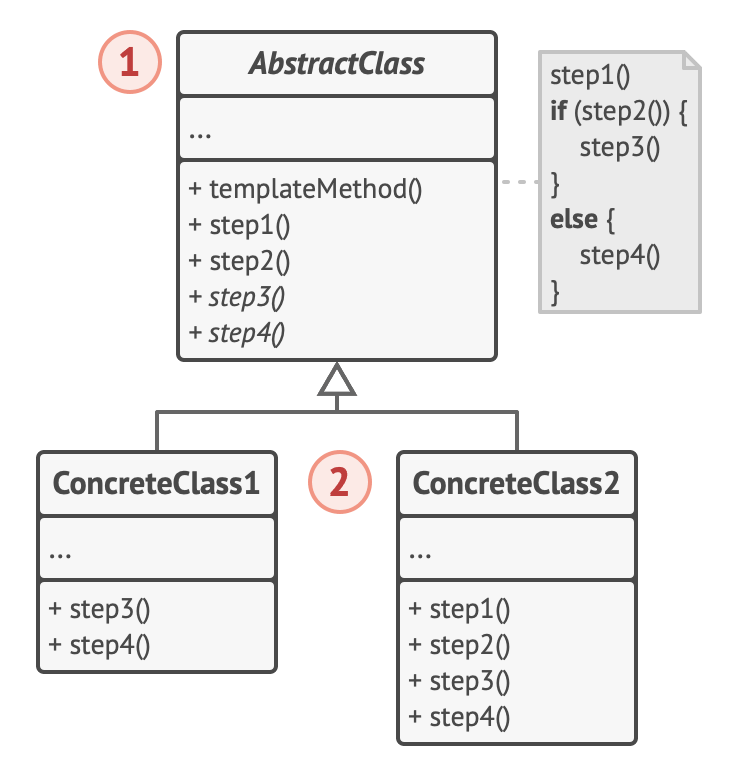
-
The Abstract Class declares methods that act as steps of an algorithm, as well as the actual template method which calls these methods in a specific order.
- The steps may either be declared abstract or have some default implementation.
-
Concrete Classes can override all of the steps, but not the template method itself.
How to use
- Use the Template Method pattern when you want to let clients extend only particular steps of an algorithm, but not the whole algorithm or its structure
- The Template Method lets you turn a monolithic algorithm into a series of individual steps which can be easily extended by subclasses while keeping intact the structure defined in a superclass
- Use the pattern when you have several classes that contain almost identical algorithms with some minor differences
- As a result, you might need to modify all classes when the algorithm changes
- When you turn such an algorithm into a template method, you can also pull up the steps with similar implementations into a superclass, eliminating code duplication
- Code that varies between subclasses can remain in subclasses
How to implement
- Analyze the target algorithm to see whether you can break it into steaps
- consider which steps are common to all subclasses and which ones will always be unique
- create the abstract base class and declare the template method and a set of abstract methods representing the algorithm's steps
- outline the algorithm's structure in the template method by executing corresponding steps
- consider making the template method final to prevent final to prevent subclasses from overriding it
- it is okay if all steps end by being abstract
- however, some steps might benefit from having a default implementation
- subclasses don't have to implement those methods
- think of adding hooks between the crucial steps of the algorithm
- for each variation of the algorithm, create a new concrete subclass
- it must implement all of the abstract steps, but may also override some of the optional ones
Pros and Cons
Pros
- can let clients override only certain parts of a large algorithm
- making them less affected by changes that happen to other parts of the algorithm
- can pull the duplicate code into a superclass
Cons
- some clients may be limited by the provided skeleton of an algorithm
- you might violate the Liskov Substitution Principle by suppressing a default step implementation via a subclass
- template methods tend to be harder to maintain the more steps they have