Linked Lists
- it is a data structure in which the objects are arranged in a linear order
- order in a linked list is determined by a pointer in each object
- consists of nodes, each with some value and a pointer to the next node in the linked list
- a linked list node's value and next node are typically stored in
valueandnextproperties - the 1st node in a linked list is referred to as the
headof the linked list - the last node in a linked list, whose
nextproperty points to thenullvalue is known as thetailof the linked list - linked lists differs from an array is in how it's implemented and how it's stored in memory
- basically it would store each node (1 memory slot) with their pointer (1 memory slot) back to back
- the pointer stores the memory address of the next node
- each node and their respective pointers are not stored back to back with the other nodes and pointers in the memory
- they are linked together via their pointers
- in the case of a singly linked list, the last node would point to the memory address that contains the null value
- basically it would store each node (1 memory slot) with their pointer (1 memory slot) back to back
- The advantage of this data structure is usage of pointers
- In languages with manual memory allocation this allows data structures to allocate memory dynamically
- In javascript, this advantage is mitigated in general, but other features of a double linked list could be used
class Node<T> {
  constructor(public element: T, public next?: Node<T>) {}
}
class DoublyNode<T> extends Node<T> {
  constructor(
    public element: T,
    public next?: DoublyNode<T>,
    public prev?: DoublyNode<T>
  ) {
    super(element, next);
  }
}
Singly Linked List

- visual representation of a singly linked list whose nodes hold integer values
0 -> 1 -> 2 -> 3 -> null
- a singly linked list typically exposes its head to its user for easy access
- while finding a node in a singly linked list involves traversing through all of the nodes leading up to the node in question (as opposed to instant access with an array)
- adding or removing nodes involves overwriting
nextpointers (assuming that you have access to the node right before the node that you're adding or removing)
- adding or removing nodes involves overwriting
- while finding a node in a singly linked list involves traversing through all of the nodes leading up to the node in question (as opposed to instant access with an array)
standard operations and their complexities
Initialize a linked list: O(n) time, O(n) space
- this will create 2n memory slots, 1 for the node and 1 for the pointer
- it will also need to allocate the n chunks of memory thus will take n time
Accessing the head: O(1) time, O(1) space
- space is not affected
Accessing the tail: O(n) time, O(1) space
- requires to traverse the linked list to get the node
- space is not affected
Accessing a middle node: O(n) time, O(1) space
- requires to traverse the linked list to get the node
- space is not affected
Inserting / Removing the head: O(1) time, O(1) space
- none of the nodes are required to be shifted, therefore it only requires changing of the head reference which is only for 1 node making it constant time and space effort
- With add operation, memory is allocated for a new node and then the pointer in the last element is updated to point to the new node.
Inserting / Removing the tail: O(n) to access + O(1) to modify time, O(1) space
- requires traversing through the list before any changing of reference could be done, therefore time is linear to traverse but modification is constant
Inserting / Removing a middle node: O(n) to access + O(1) to modify time, O(1) space
- requires traversing through the list before any changing of reference could be done, therefore time is linear to traverse but modification is constant
Searching for a value: O(n) time, O(1) space
Traverse a linked list: O(n) time, O(1) space
- space is not affected
Copy a linked list: O(n) time, O(n) space
Doubly Linked List

- similar to a singly linked list, except that each node in a doubly linked list also has a pointer to the previous node
- the previous node is typically stored in a
prevproperty
- the previous node is typically stored in a
- just as the
nextproperty of a doubly linked list'stailpoints to thenullvalue, theprevproperty of a doubly linked listheadalso points to thenullvalue - visual representation of a doubly linked list whose nodes hold integer values
null <-> 0 <-> 1 <-> 2 <-> 3 <-> null
- a doubly linked list typically exposes both its head and tail to its user
- it also behaves very similarly to a singly linked list
standard operations and their time complexities
Initialize a linked list: O(n) time, O(n) space
- this will create 2n memory slots, 1 for the node and 1 for the pointer
- it will also need to allocate the n chunks of memory thus will take n time
Accessing the head: O(1) time, O(1) space
Accessing the tail: O(1) time, O(1) space
Accessing a middle node: O(n) time, O(1) space
Inserting / Removing the head: O(1) time, O(1) space
Inserting / Removing the tail: O(1) time, O(1) space
Inserting / Removing a middle node: O(n) to access + O(1) to modify time, O(1) space
Searching for a value: O(n) time, O(1) space
Traverse a linked list: O(n) time, O(1) space
- space is not affected
Copy a linked list: O(n) time, O(n) space
Circular Linked List / Cyclic Linked List

- a linked list that has no clear
headortail- because its
tailpoints to itshead - forming a closed circle
- because its
- it can be either singly circular linked list or a doubly circular linked list
Circular Double Linked List / Cyclic Double Linked List
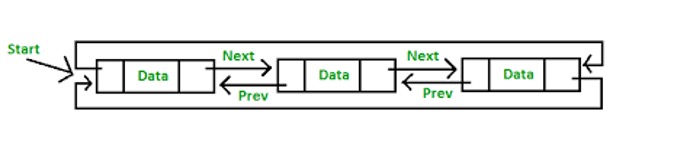
- the last element is pointing to the first and first points to the last